Contributors

Sunday, February 20, 2011

Leaving McMurdo

The days since my last post have been crazy. We were finally able to board the ship on the 17th at 13:00. The loading of the ship with our equipment from the containers to the ship, to my surprise, went very smoothly. We formed human chains, working together as a team to get all equipment on board. I was very impressed and happy with the teamwork. Unfortunately I did not get to set up in the laboratory I had originally planned on because the other group occupying space in that laboratory are analyzing samples for helium and tritium and, apparently, they use liters of isopropanol that are allowed to volatilize into the atmosphere. First of all I was unsure if large amounts of volatilized isopropanol would compromise my samples and, secondly, I didn’t want to breath in isopropanol vapors every day. Luckily there was plenty of space still available in the wet lab, which actually worked out better for my storage needs. We set sail yesterday and have been steaming towards our first station. We have a 10:45 meeting to discuss the sampling plan and Jim Swift, the chief scientist, will also give a brief explanation of the CLIVAR (Climate Variability) program. It seems the cruises associated with the program are primarily chemistry-oriented. My self and my colleague Emily represent, as far as I know, the only biological component. I don’t really have a solid sampling plan yet, although I have some ideas. I will keep you posted on what develops.

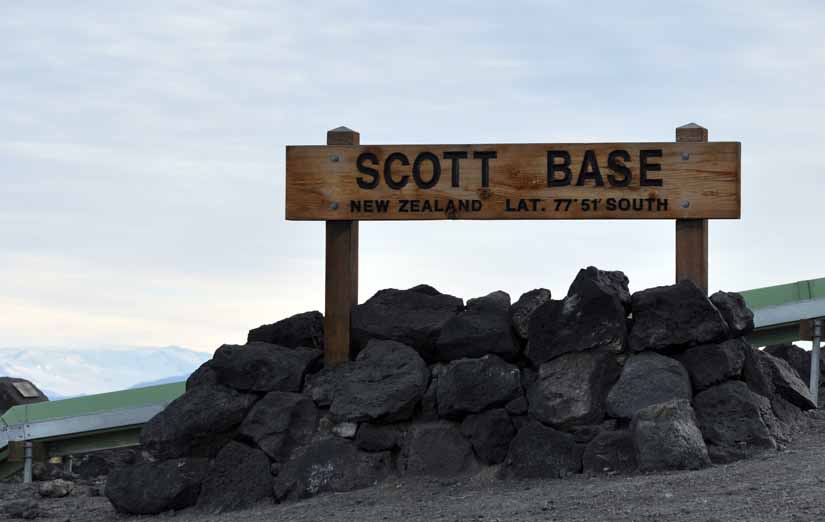
Prior to our departure, we did get an opportunity to visit Scott Base, the New Zealand Antarctic Station near McMurdo. Normally, scientists from other countries cannot visit the station unless they are invited. But, I guess they host an ‘American night’ once a week when McMurdo dwellers can at least visit the gift shop and the bar at the station. I also was forced to sing a little karaoke one night but I am going to try and forget that part. On a side note, we did get to see the sun 'sort of' set while we were still in McMurdo. It was a beautiful site.

We haven’t seen too much wildlife yet. We saw some penguins and seals in the distance but they were little dots in the distance. As we were leaving McMurdo, we did see some whales in the very distance. I did get a couple of pictures and you can see a teeny tiny dorsal fin above the water. But hey, it’s a whale. Right now we are in open water, so there is less of a chance to see wildlife. But I will keep you posted.

Chow.

Wednesday, February 16, 2011

Notes from McMurdo Station


--The last few days in McMurdo represent our last minutes of relaxation before the cruise. Most of us spent time hiking a few of the trails around here to get a 360ยบ view of Ross Island where McMurdo Station is located. Many of us climbed Observation Hill the first day we arrived. The sun was out and the temperature was comfortable. It is a steep hill but a good workout and a nice view of the island. A cross was erected at the top of Ob Hill to commemorate Captain Scott and the other lives lost on their return from the South Pole in 1912. From there, and many other locations around the station, one can view the various islands and mountains that border Ross Island and the inlet, such as Mount Discovery and Black Island. On our Tuesday (your Monday) we were given a tour of Captain Scott’s Hut that was built on Cape Evans in 1911. The hut actually came from a kit that was purchased in Australia. Unfortunately it was not made for the cold conditions in Antarctica. On the contrary the materials were supposed to be used for the hot climate of Australia (to keep people cool inside) so the temperature was actually colder in the hut than outside. So my understanding is that Scott and his crew stayed in their ship most of the time. We weren’t allowed to touch the walls or any artifacts inside to preserve those items. Also there were areas that contained asbestos and anthrax, so those areas were roped off. It was a very windy day and the wind was bitter cold. By the end of the tour froze my toes and face.

Yesterday a group of us hiked another trail that took us around Ob Hill. We had a nice view of the surrounding ice and hundreds of seals in the distance lazing on the ice. At one point we stopped to listen to the ice heaving against the land. It was an eerie creaking sound and you could see the slight movement of the ice with the water.

--Last night at about 11:00 pm I walked down to the water’s edge. The Sun was at a low point in the horizon behind Mount Discovery. It had almost a sunset look to it, although it isn’t setting yet. The orange and yellow colors on the ice, and the sound of the water lapping the ice, provided a truly magical seen. I just stood there for about 10 minutes in awe of the scene. Of course I started getting philosophical at that point, just thinking about why people want to come here. What is the draw? Explorers have lost their lives to understand this place. Why? I think people are drawn here because Antarctica still provides a level of mystery, and it is still vastly untouched by humans. There is no beachfront property for us to flock. I personally hate the cold. HATE it. But I suffer through it because being here is a unique and life changing experience and I will take any opportunity to return.

--Today we finally get to board the ship and the process of setting up equipment in the lab spaces. The process is hardly ever smooth but we always make it work. We shall see how it goes.


Until next time....

Monday, February 14, 2011

Journey to McMurdo


Greetings from the far south! (BTW, the time line of the pictures is backwards; start from the bottom up). We finally made it to McMurdo Station, Antarctica. I awoke at 5:30am to catch the continental breakfast our B&B provided before our shuttle arrived at 6:45am. At the Clothing Distribution Center (CDC) we picked up our extreme cold weather (ECW) gear, went through customs and checked into our flight. We were limited to 150lbs for baggage, including a boomerang bag. The boomerang bag is essentially an overnight bag that contains the items we would need if we had to return to New Zealand because of bad weather (i.e. boomerang back to NZ). Rules for the flight are somewhat similar. We have to go through the same screening process as normal airports except we don't have to take off our shoes and liquids are not limited to 3oz. We are also required to wear the ECW gear that consists of a large red parka, bib wind pants, fleece pants and goggles on the flight, just in case we crash land I guess.

The flight left New Zealand at about 10:00am. We were given a very plentiful bagged lunch (just in case we had to boomerang). It was a very uneventful flight 5 hour flight (operated by the U.S. Air Force) on an C-17 and a smooth landing on the ice runway (Pegasus) here in Antarctica, arrival time at about 3pm. We arrived on a very beautiful, sunny day (-11 degrees F, though). It took about an hour or so to ride in 'Ivan the Terrabus' from the runway to McMurdo station, passing the New Zealand station (Scott Base) on the way. The rest of the day consisted of safety briefings, collecting our bedding for the dorms, dinner at the station and a walk up to Observation Hill. I will save that for a separate post.